
Intelligence Summary: UK Intelligence Oversight and Strategic Risk Analysis Annual Report 2023-2025 Assessment
25/25

BLUF
The ISC Annual Report 2023–2025 signals that the UK intelligence oversight is under strain from remit gaps, reducing shortfalls, and government obstruction, even as state threats particularly from china and expanded powers under new legislation increase the risk of unchecked activity.
Key judgements
China as a Strategic Threat: China poses a long-term, systemic challenge across espionage, political interference, technology, academia, and critical infrastructure. The UK response remains fragmented and under resolved, leaving significant vulnerabilities. Agencies have prioritised covert threats, while overt influence has been left unequipped policy teams creating gaps in a whole-of-state approach
International Partnerships and Risk Exposure: Intelligence partnerships remain a vital force multiplier for UK capabilities. Compliance and human rights safeguards have improved, but working with partners that do not share legal and ethical standards continue to carry reputational and legal risk.
Legislative Expansion and Oversight: Recent laws such as the National Security Act 2023 and Investigatory powers (Amendment) Act 2024 significantly expand the UK counter state tool kit and data access powers. Their safe guard depends on effective oversight, which is under strain. ISC interventions have strengthen safeguards (e.g. Triple lock for MPs, limits on bulk datasets) but these wins highlight how easily protections can erode without persistent scrutiny.
Comment: The triple lock in this context is a key protection within the Investigatory powers framework, designed to ensure the highest level of accountability for intrusive intelligence activities, this includes three layers of approval, first the Secretary of State (Initial), Judicial Commissioner (Independent legal review), Prime Minister (Final Sign off) End Comment.
Oversight Capability Under Pressure: The ISC ability to deliver comprehensive oversight is constrained by three factors:
An out dated Memorandum of Understanding excluding key policy units.
Severe resourcing and governance shortfalls within the ISC office.
Delays and obstruction in government engagement with enquires. At times, these issues left the Committee unable to perform its statutory functions and strategically significant warning.
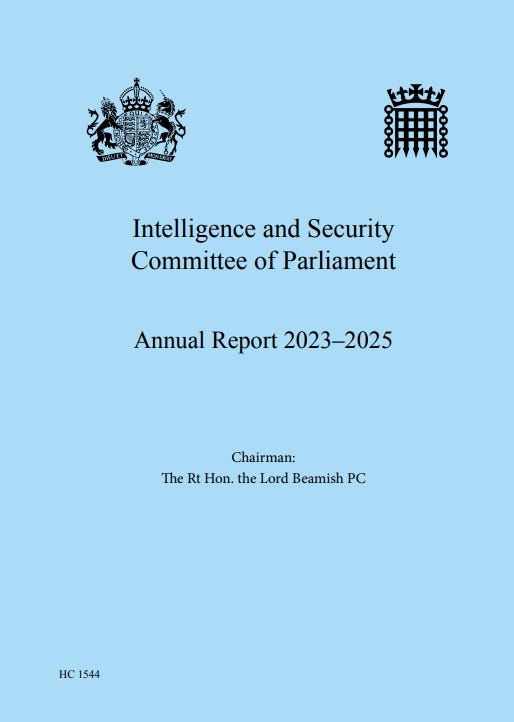
Assessment
The report highlights a growing tension between the UK’s expanding intelligence powers and the weakened state of parliamentary oversight. New authorities under the National Security Act 2023 and Investigatory Powers (Amendment) Act 2024 require robust scrutiny, The report states that the ISC’s remit and resources have not kept pace.
China remains the most significant long-term threat. The UK’s slow, fragmented response contrasts with Beijing’s whole-of-state strategy, leaving vulnerabilities across academia, technology, and critical infrastructure. Its highly likely that without decisive action—investment screening, research safeguards, and clear departmental ownership, strategic dependencies will deepen.
International partnerships strengthen UK capability but carry legal and ethical risks when partners operate below UK standards. Failure to enforce strict governance is likely to trigger scandals, erode trust, and disrupt cooperation.
The ISC’s intervention on the Investigatory Powers amendments prevented dilution of safeguards on warrants, bulk datasets, and communications data—underscoring how fragile privacy protections are without persistent oversight.
The ISC warns that remit gaps and resourcing shortfalls have at times prevented it from fulfilling statutory functions. This raises the possibility of intelligence activity occurring with incomplete parliamentary scrutiny. If unaddressed, the UK faces escalating risks: legal challenge, erosion of public trust, and strategic misalignment—risks that will intensify as AI-driven surveillance and bulk data exploitation expand.
Report link: https://isc.independent.gov.uk/wp-content/uploads/2025/12/ISC-Annual-Report-2023%E2%80%932025-Web-Accessible.pdf
Conclusion
For senior decision‑makers, the report therefore functions as both assurance and warning. It demonstrates that robust, expert oversight can materially improve national security legislation and practices when properly empowered.
Equally, it signals that unless the ISC’s remit is updated to encompass “substantively all” central government intelligence and security activity and its office is resourced to match the scale and complexity of the threat environment, the UK’s intelligence advantage and the legitimacy of its expanding powers will rest on an increasingly fragile democratic foundation.
Failure to act risks eroding public trust and weakening the UK intelligence advantage at a time of intensifying global competition.